 David
Is there finally an AI model that makes a real leap forward? Or is it just another small upgrade with a new name?
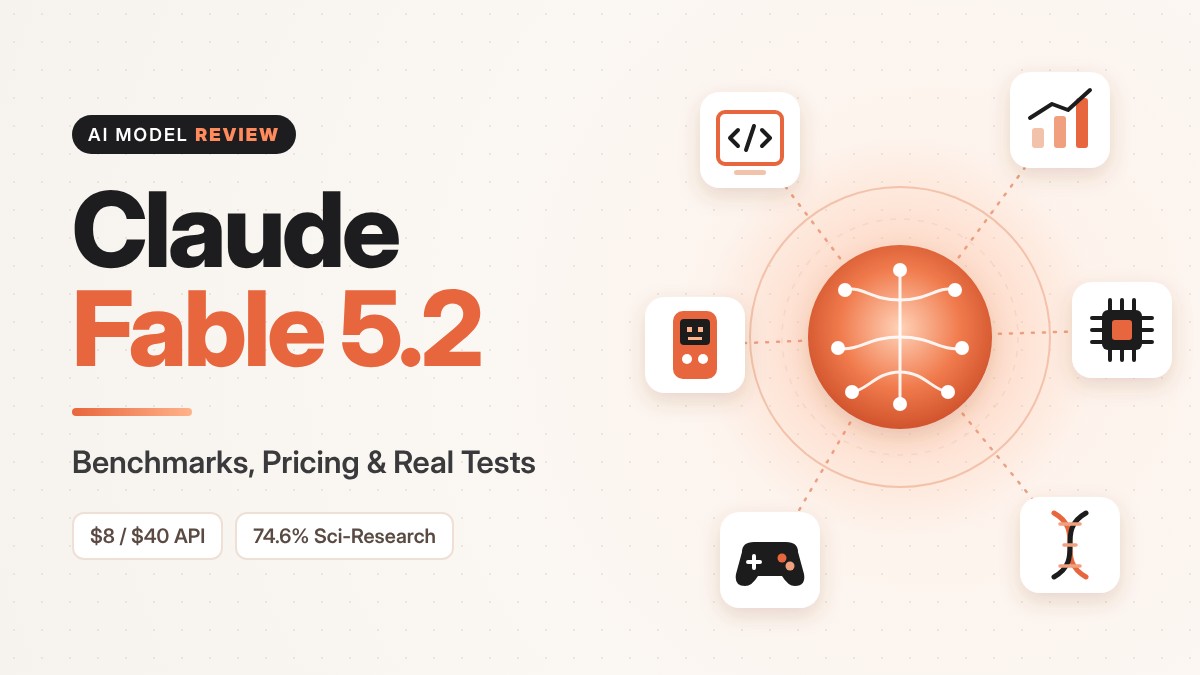
Anthropic just released Claude Fable 5.2 alongside Mythos 5.2, and early tests suggest it’s a big step up for hard problems.
Continue reading, to find out what Claude Fable 5.2 can do, how much it costs, and whether you should switch from Opus 5.5.
- What Is Claude Fable 5.2?
- Fable 5.2 vs Opus 5.5
- Claude Fable 5.2 Benchmarks
- Reasoning Levels and Diminishing Returns
- Artificial Analysis Ranking
- Claude Fable 5.2 Pricing
- How to Access Fable 5.2
- Anthropic's Fable 5.2 Examples
- Fable 5.2 Game Test
- Fable 5.2 Hardware Test
- Community Fable 5.2 Demos
- Is Claude Fable 5.2 Worth It?
- FAQs
What Is Claude Fable 5.2?
Claude Fable 5.2 and Mythos 5.2 are essentially the same model. Fable is the public version, with extra cybersecurity guardrails added.
Mythos 5.2 is the unrestricted version. Access is mostly limited to cybersecurity testers.
Anthropic positions Fable for the most ambitious, open-ended technical work. That includes theoretical physics, protein folding, mathematical formalization, hardware, and robotics.
Fable 5.2 vs Opus 5.5
Anthropic doesn’t recommend Fable for everyday tasks. For most coding and knowledge work, it suggests starting with Claude Opus 5.5, which it calls the strongest daily driver.
Fable also works well as an adviser or orchestrator. It can plan the big picture and hand simpler jobs to Haiku, Sonnet, or Opus.
That setup is a natural fit for AI agents that split work across several models.
Claude Fable 5.2 Benchmarks
Fable 5.2 sets a new state of the art on most of the benchmarks Anthropic published. The gains in everyday coding are steady rather than huge.
On Frontier Code, agentic coding went from 45.5% with Opus 5 to 49.1%. On Frontier SWE V2, the score went from 62 to 69.
The biggest jump is in agentic scientific research. Fable 5.2 scored 74.6%, ahead of GPT-6 Astra at 68.1%, Gemini Carbon at 64.8%, and Opus 5.5 at 58.7%.
It also leads in cybersecurity, protein design, agentic search, computer use, robotics, and visual chart recognition.
It doesn’t win everywhere. Gemini Carbon beats it in business workflows by about two points, and Opus 5.5 edges it out on one knowledge-work benchmark.
Reasoning Levels and Diminishing Returns
Longer thinking doesn’t always help. On Frontier Code 2.0, Fable 5.2 scored higher on extra high effort than on max.
Max effort cost more and performed slightly worse. For most work, extra high is the better choice.
Fable on high also scored about the same as Opus 5.5 on max, at a lower cost. For some coding tasks, that makes Fable the cheaper option.
Artificial Analysis Ranking
Artificial Analysis combines many benchmarks into a single intelligence score. Fable 5.2 now sits at the top, ahead of Gemini 4 Carbon.
It’s also the most expensive model on the chart. At max reasoning, the average task costs about $26.54.
On the plus side, it uses fewer output tokens per task than Sonnet 5.5.
Claude Fable 5.2 Pricing
The Fable 5.2 API costs $8 per million input tokens and $40 per million output tokens. That’s double the price of Opus 5.5.
It’s cheaper than Fable 5.1, which cost $10 and $50. It also undercuts GPT-6 Astra, which is priced at $10 and $50.
See how it stacks up against other new releases in our GPT-5 vs claude 4 comparison.
How to Access Fable 5.2
Fable 5.2 is available through the API and in the Claude app’s model dropdown. You need a paid plan, and free users can’t select it.
During launch week, Anthropic is giving paid users extra usage and limit resets. That bonus usage is temporary.
Anthropic’s Fable 5.2 Examples
In one experiment, an Anthropic engineer asked Fable 5.2 to design a prototype operating system from an empty folder.
The model coordinated over 1,000 subagents for eight days. The result boots on a laptop, with drivers, file storage, windows, a login screen, and an installer.
It also used two open-source protein folding models to find a new way to predict a whole capsid structure.
From a one-paragraph prompt, it designed three working electronic devices. Each came with its own circuit board, 3D-printed case, and software.
Fable 5.2 Game Test
When asked to clone a popular 3D game, Fable declined to copy it. Instead, it built an original horde-survival game in the same genre.
On medium reasoning, the game took about 16 minutes to generate and worked on the first try. Sprinting, stamina, level-ups, and double jumps all worked.
The mechanics were solid, but the graphics and sound were basic. In this test, Opus 5.5 handled visual design slightly better.
Fable 5.2 Hardware Test
Fable was asked to design a handheld desk gadget with a pixel-art character that reacts to button presses.
It picked real off-the-shelf parts, including a Raspberry Pi Pico, a display, and buttons. It also wrote the firmware and wiring guide.
It produced four STL files for 3D printing the case. On high effort, it then created an illustrated assembly manual in about 15 minutes.
Community Fable 5.2 Demos
Early testers shared impressive results. They included polished 3D shooter-style games and a racing game.
One tester built working clones of a photo editor and a video editor, plus a voice changer app. In total, they made 23 demos.
Another created a 20-second animated travel ad entirely in code, with music included. It’s a big step for AI video creation.
One builder even made a “mirror Earth” game. It’s a voxel world where you can go anywhere, destroy things, and see real-time weather.
Is Claude Fable 5.2 Worth It?
For everyday research, writing, or small coding projects, you won’t see a huge jump over Opus 5.5.
Fable 5.2 shines on very hard problems. That means complex games, tough bugs, scientific work, and real-world hardware builds.
FAQs
What is Claude Fable 5.2?
Claude Fable 5.2 is Anthropic’s most powerful public AI model. It is the same model as Mythos 5.2, with added cybersecurity guardrails.
What is the difference between Fable 5.2 and Mythos 5.2?
They share the same underlying model. Mythos 5.2 has fewer cybersecurity restrictions and is mainly available to security testers.
How much does the Claude Fable 5.2 API cost?
It costs $8 per million input tokens and $40 per million output tokens, which is double the price of Opus 5.5.
Can free users access Claude Fable 5.2?
No. Fable 5.2 is only available on paid Claude plans and through the API.
Should I use Fable 5.2 or Opus 5.5?
Use Opus 5.5 for everyday coding and knowledge work. Switch to Fable 5.2 for very hard, open-ended technical problems.
Is max reasoning the best setting for Fable 5.2?
Not always. Benchmarks show extra high effort can outperform max while costing less.
Advertisements


 David